
White gold Daytonas have always been a problem for rep factories. 18K white gold is a lot denser than stainless steel, which means a steel rep of a white gold reference feels wrong the second you pick it up. The standard fix — thicken the case to add weight — ruins the Daytona's 12.1mm profile and makes the watch sit awkwardly on wrist. Neither option works if you care about how the watch actually wears.
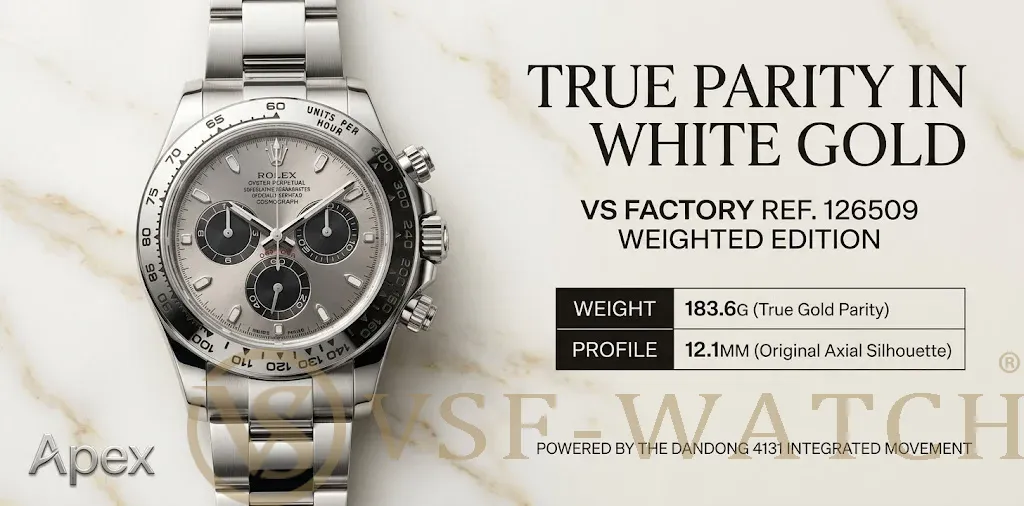
VSF Watch new weighted edition takes a different approach. Tungsten-matrix core inside a 904L steel shell. The case dimensions stay at gen spec, but the weight jumps to 183.6 grams. That's close enough to solid white gold that most people won't question it on wrist. The movement is the Dandong 4131 — same integrated chronograph they use across their 126xxx Daytona line.
Table of contents
How the weight works: 183.6g at 12.1mm
Dial: the 126xxx generation updates
Macro details: pinion, hands, and coronet
Case finishing and hallmarks
Movement: Dandong 4131
Spec comparison
1. How the weight works: 183.6g at 12.1mm
The interesting bit is the tungsten core. Instead of making the whole case out of steel and living with the weight deficit, VSF machined an internal tungsten-matrix structure and wrapped it in 904L steel.
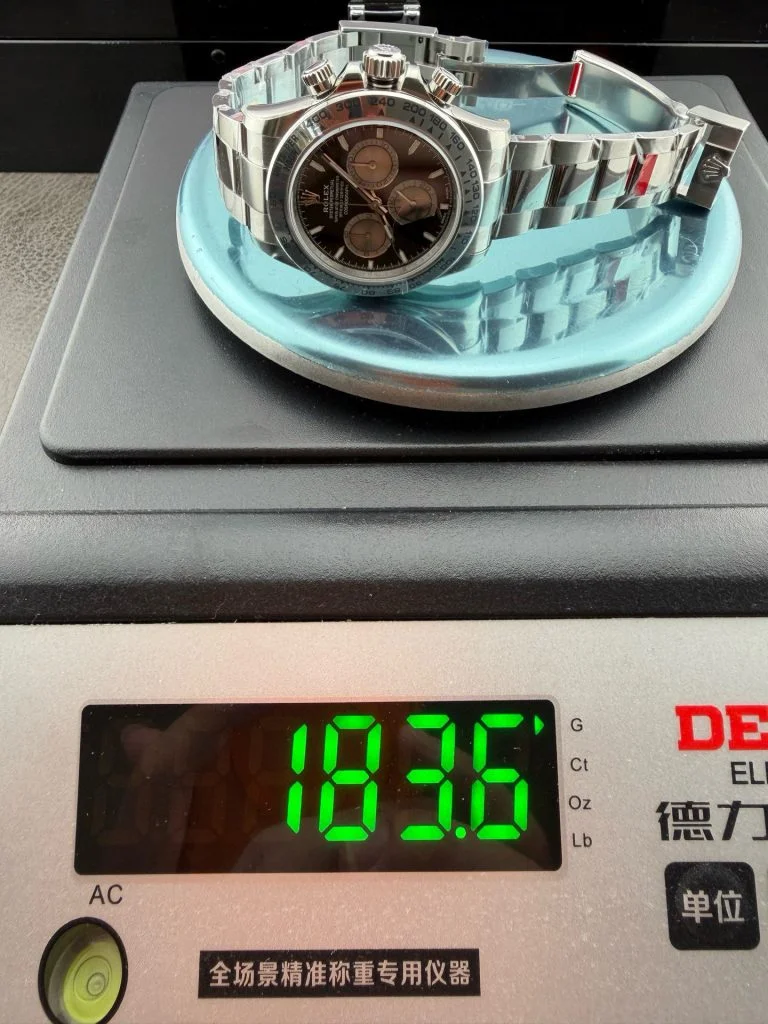
The result, on a calibrated scale, is 183.6 grams. For context, a standard steel Daytona rep runs about 140 grams. A gen white gold Daytona is north of 200 grams depending on bracelet configuration. 183.6 isn't identical, but it's close enough that the watch doesn't feel hollow when you pick it up.
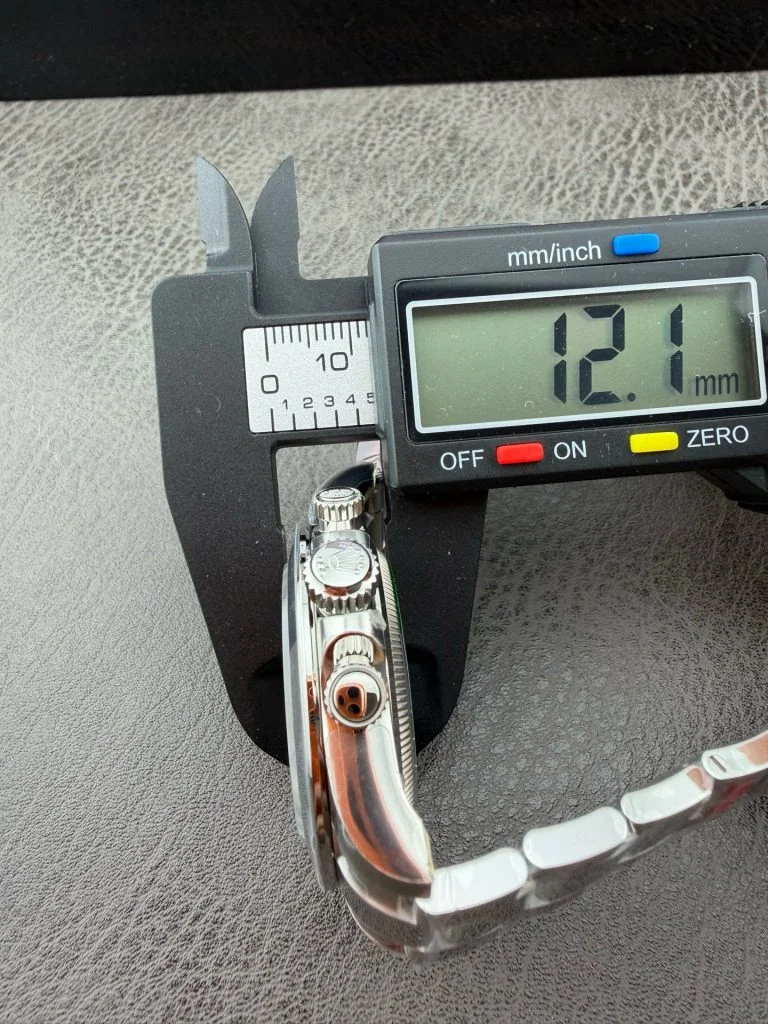
The caliper reading confirms 12.1mm thickness. VSF didn't bulk up the case to hit the weight number. The profile is still slim, still fits under a shirt cuff, still feels like a Daytona should feel. That's the part that matters — mass without bulk.
2. Dial: the 126xxx generation updates
The 126xxx Daytona dial is cleaner than the 116xxx it replaced. Slimmer applied indices, narrower sub-dial rings, more open space across the dial. VSF's slate gray sunburst on the 126509 shifts naturally as the light moves — subtle, not overpowering. The text printing looks like oil-ink application rather than flat pad printing, with discernible height when viewed off-angle.
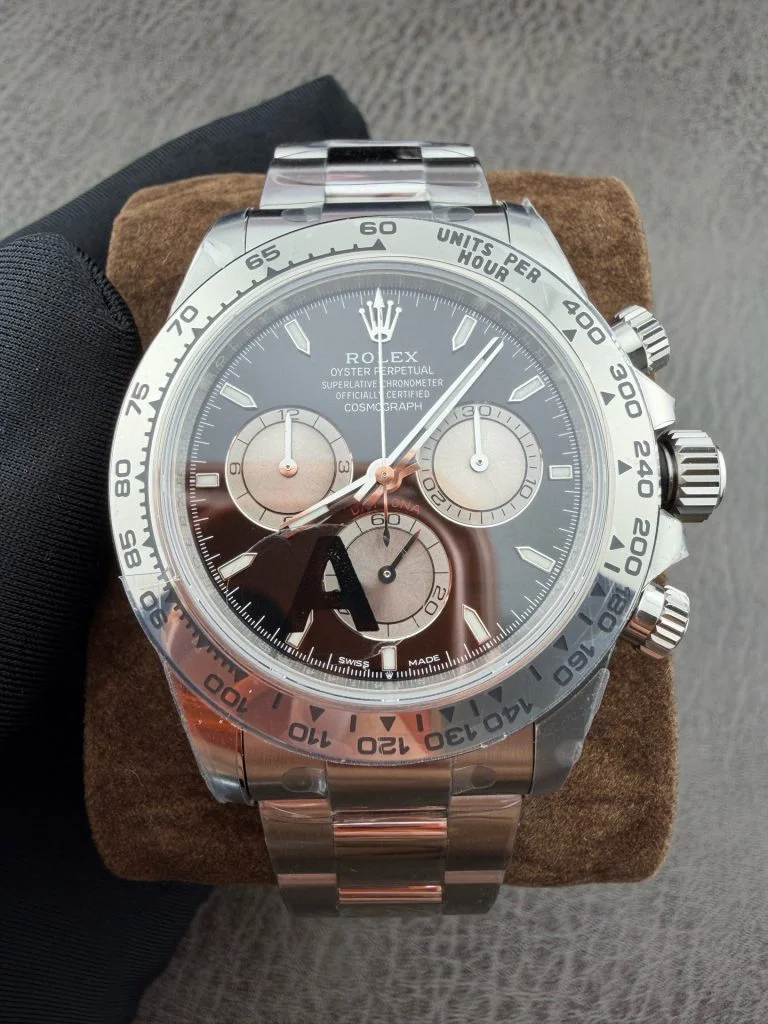
The hour markers are the narrow, elongated style that matches current-gen tooling. The black snailed outer rings on the chronograph sub-dials are thinner than what you see on older-gen reps, which gives the dial more breathing room. These changes are small in isolation but together they change how the watch reads at arm's length.
3. Macro details: pinion, hands, and coronet
The center hand stack is one of the first places to look under a loupe. Cheaper Daytona reps often have a hollow-looking center pinion where the hands mount, which is immediately wrong. VSF used a solid mushroom-style cap on the center pivot. It's tight, it's polished, and it doesn't look like a tube with hands stuck on top.
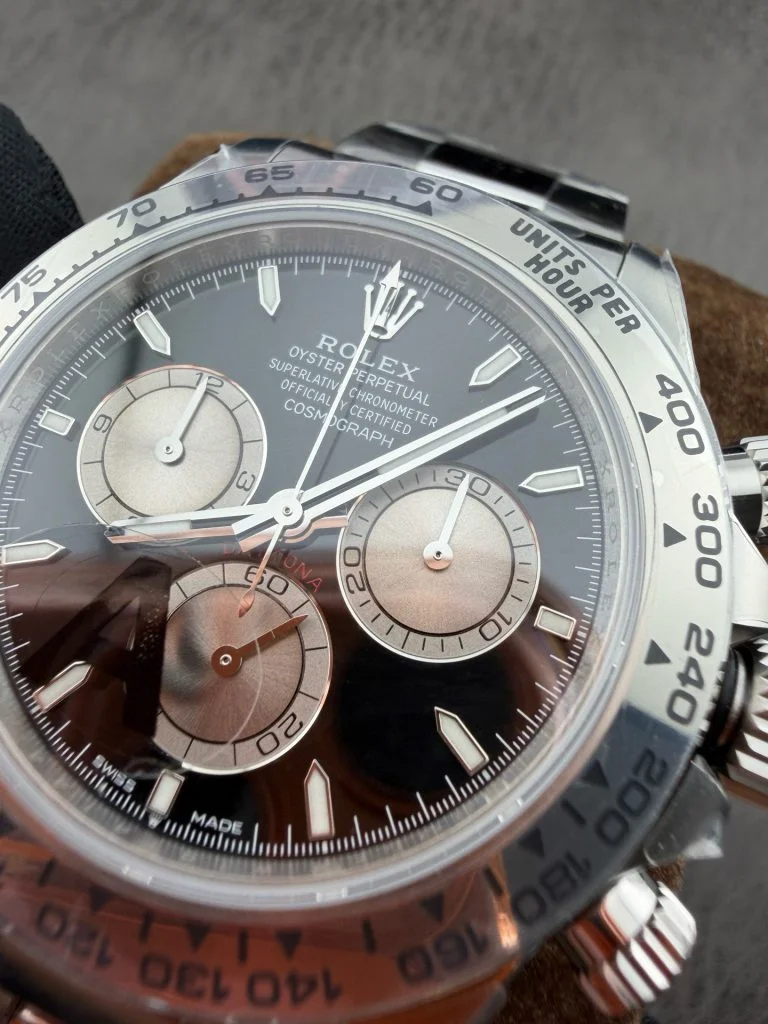
The hands are sourced from Buff Factory — beveled edges, clean plating, no rough cut marks along the sides. The micro-printed coronet at 6 o'clock inside the "SWISS MADE" track is properly sized and positioned. It's a small detail that budget factories tend to stretch or misalign, and once you notice it on a bad rep you can't unsee it.
4. Case finishing and hallmarks
The 904L case gets a multi-stage polish. The lug curves are smooth, the crown guard transitions are clean, and there are no sharp edges where the bracelet meets the case.
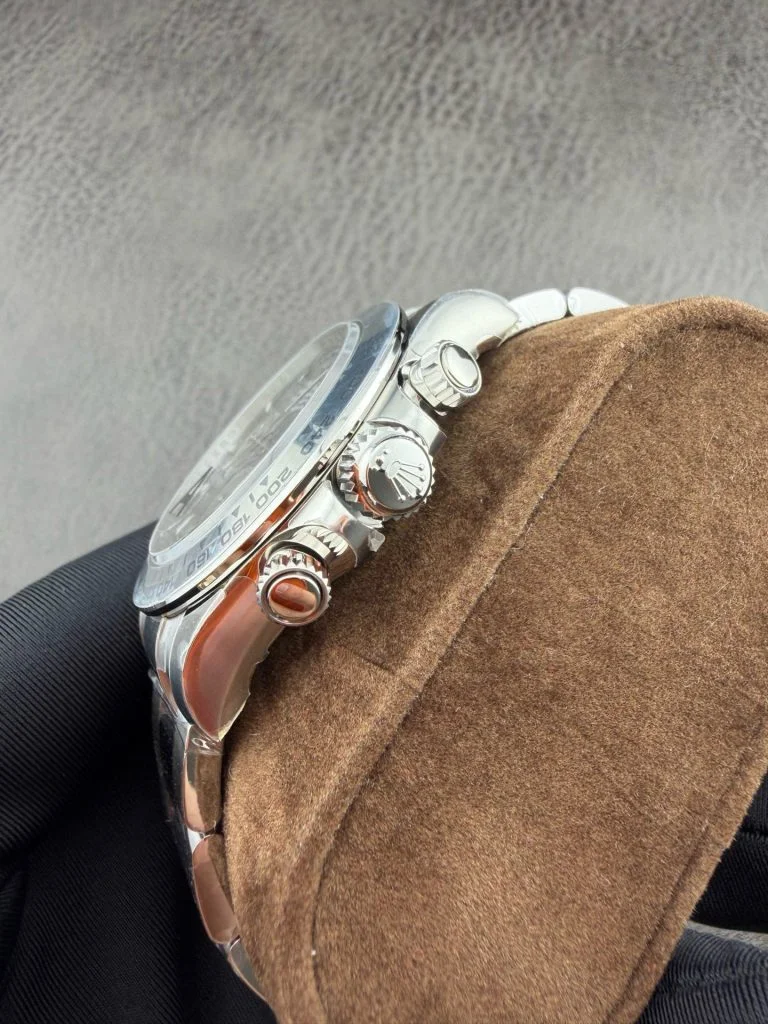
Budget Daytona reps often have rough transitions at the lugs — you feel it when you run a finger along the underside.
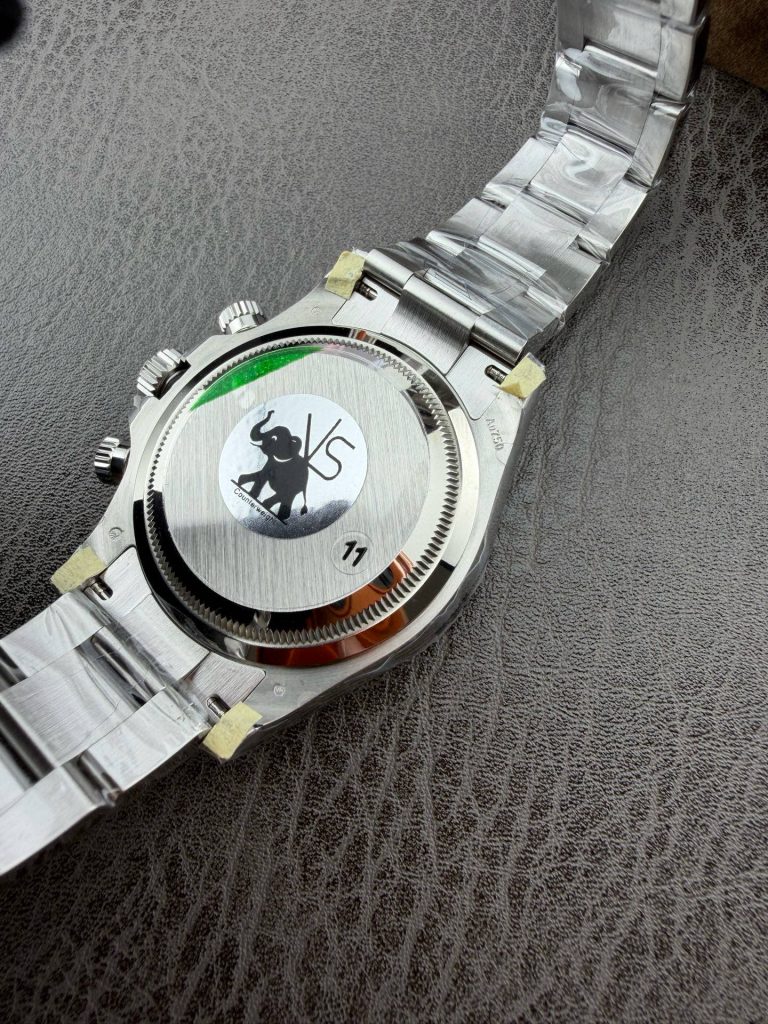
The hallmarks on the back of the lugs are deep-stamped, not laser-etched. "Au750," the Saint Bernard dog head, and the responsibility mark are all legible under a standard loupe. Shallow etching wears down over time, especially if the watch is regularly handled. Stamped marks hold up better and read more naturally on a case that's trying to pass as precious metal.
5. Movement: Dandong 4131
Same movement VSF uses across their 126xxx Daytona line. Integrated chronograph architecture — column wheel, vertical clutch, proper gear layout. Not a modified 7750 with shifting plates. The chronograph pushers engage with a clean click, the seconds hand doesn't stutter on reset, and the crown positions feel right.
Rated at about 72 hours of power reserve. That's enough to take the watch off Friday evening and have it still running Monday morning. Most 7750-based clones top out around 40-48 hours, so the difference is practical rather than academic. The trade-off is serviceability — fewer watchmakers are familiar with the 4131 architecture than the 7750, which is something to factor in before buying.
6. Spec comparison
| Parameter | VSF Weighted Edition | Standard competitors |
|---|---|---|
| Total weight | 183.6g (closer to precious metal feel) | ~140g (standard steel feel) |
| Case thickness | 12.1mm (1:1 profile) | 12.8mm-13.5mm (visibly thicker) |
| Pinion assembly | Solid mushroom-style cap | Hollow or open-pipe style |
| Lug hallmarks | Deep-stamped Au750 and precious metal marks | Shallow laser etching or none |
| Movement | Dandong 4131, ~72h reserve | Modified 7750, shorter reserve |
Bottom line: The tungsten weighting is the reason to pay attention to this release. 183.6 grams at 12.1mm thickness is the right combination — weight without bulk. The rest of the build (dial, hands, hallmarks, 4131 movement) is consistent with what VSF has been doing across their recent Daytona releases, which is to say it's good. The main thing to be aware of is the 4131 serviceability issue. If you live somewhere with access to a watchmaker who works on clone movements, it's a non-issue. If you don't, factor in that the 7750-based alternatives are easier to get fixed even though they're less accurate to gen.