

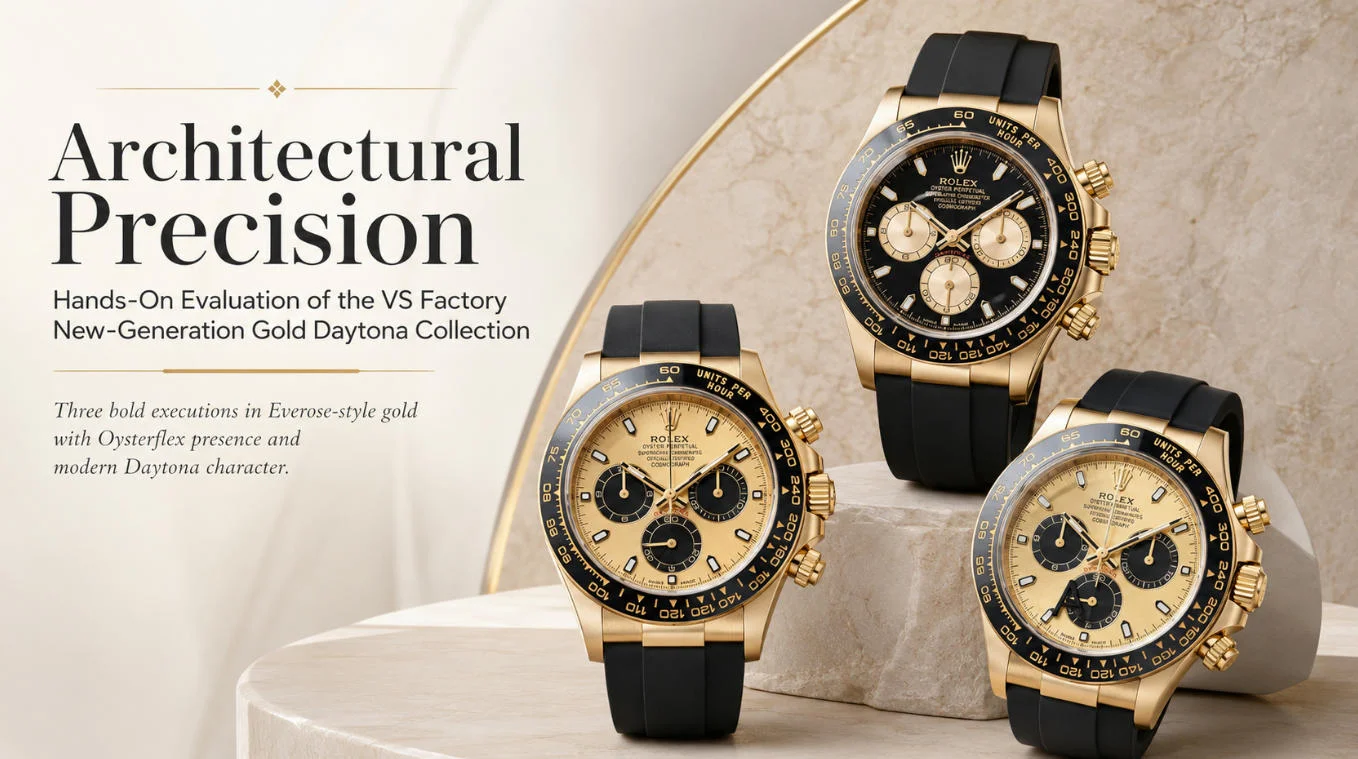
The 126xxx generation Daytona changed more than the movement. Rolex slimmed down the indices, reshaped the sub-dials, and added a metal protective ring around the ceramic bezel on Oysterflex models. Those are the kinds of changes that are easy to describe and hard to replicate. Precious metal variants make it harder still — the plating has to hold up under wear, and the color matching across different gold tones leaves almost no margin for error.
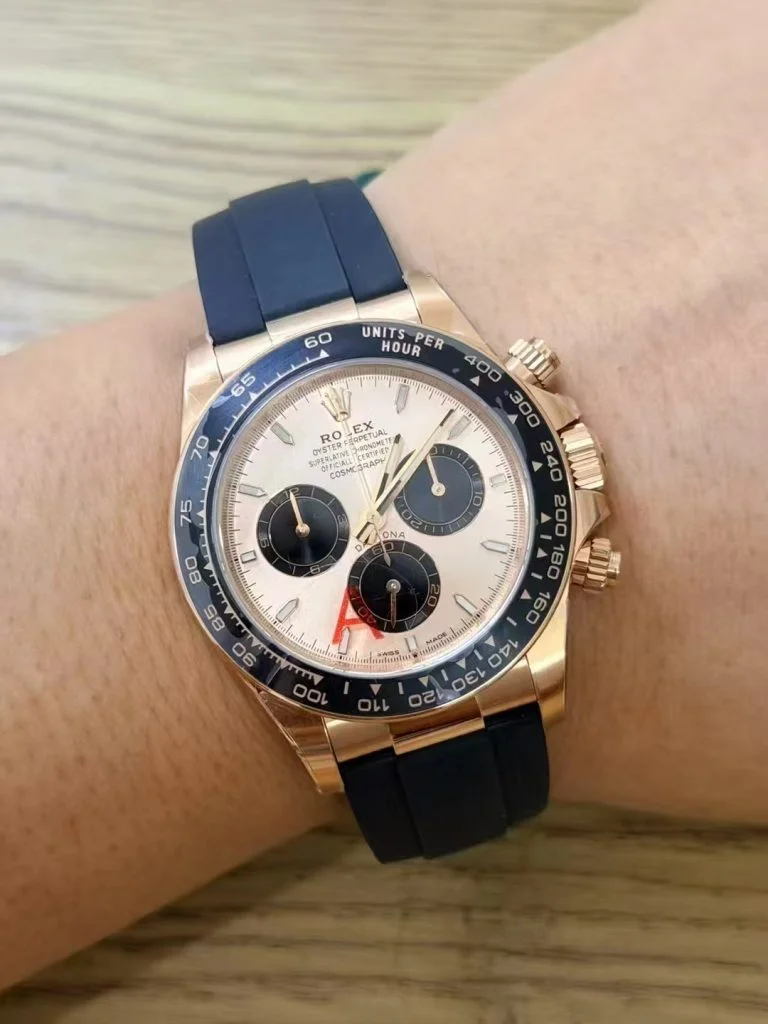
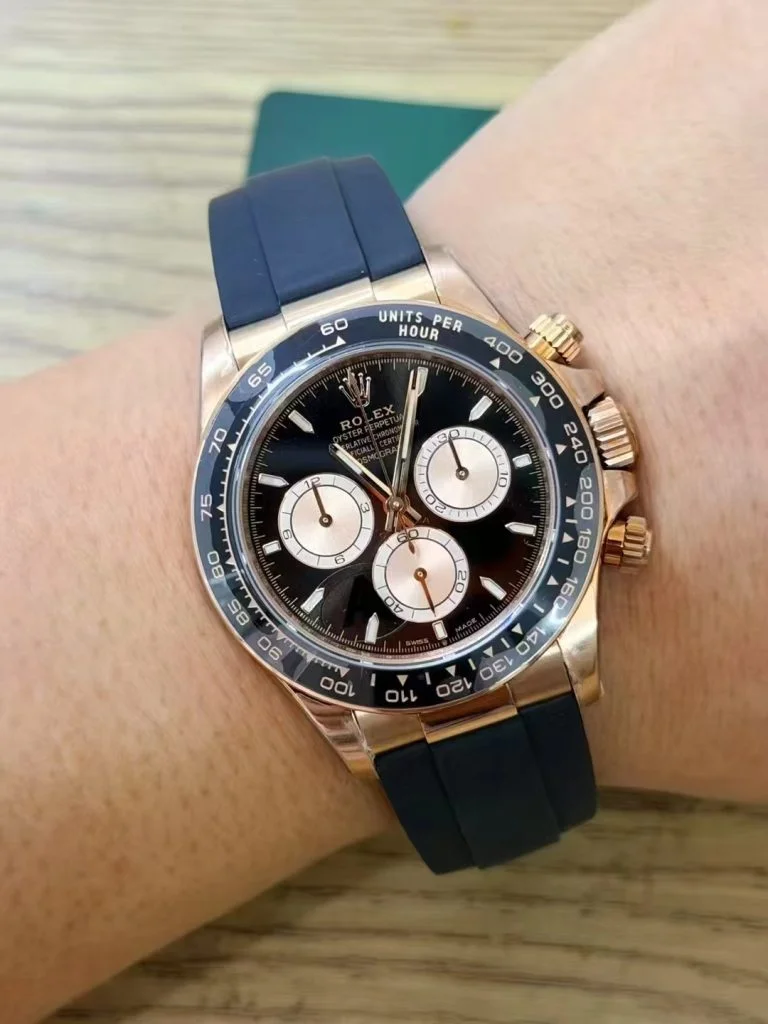
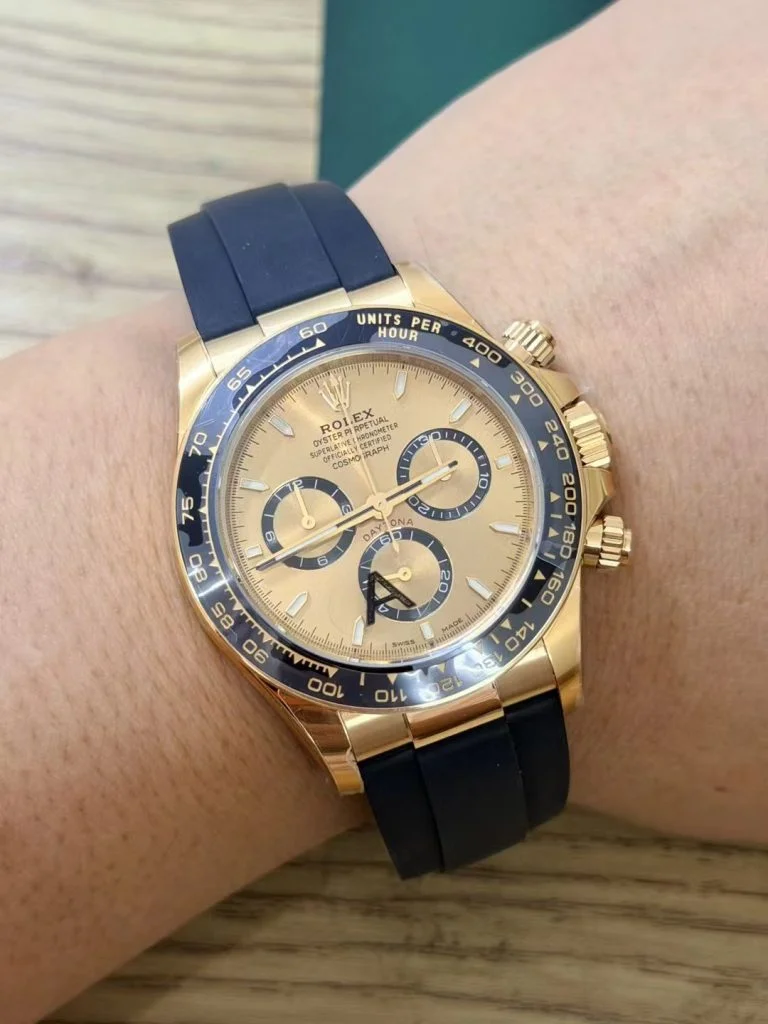
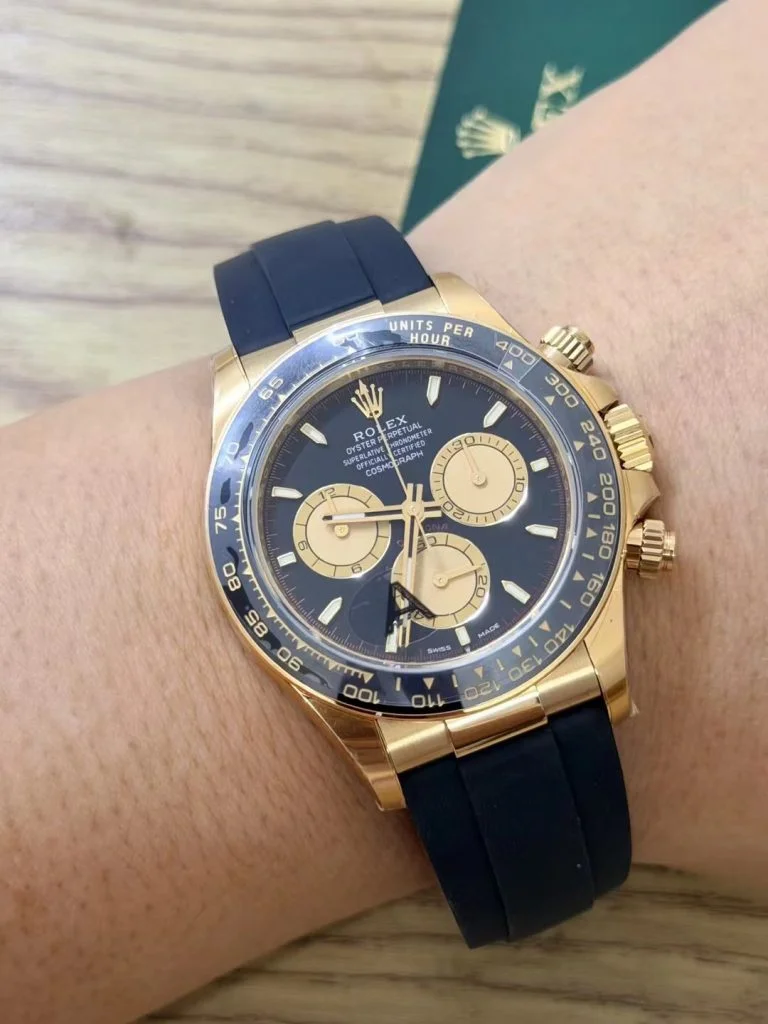
VSF Watch sent over their new precious metal and Oysterflex Daytona collection: Yellow Gold 126518LN, full gold 126508, and Everose Gold 126515LN. All three use the Dandong 4131 integrated movement. Here's how each variant holds up, with wrist shots to back it up.
Table of contents
Dial: slimmer indices and color accuracy
Bezel: metal-edged ceramic vs. full gold
Strap and bracelet: Oysterflex and case finishing
Movement: Dandong 4131 caliber
Spec summary
1. Dial: slimmer indices and color accuracy
The 126xxx dial looks cleaner than the 116xxx it replaced, mostly because the indices are narrower and the sub-dial rings are thinner. Budget factories often reuse old 116xxx dial blanks on their 126xxx reps, which throws off the spacing and makes the dial look cramped.
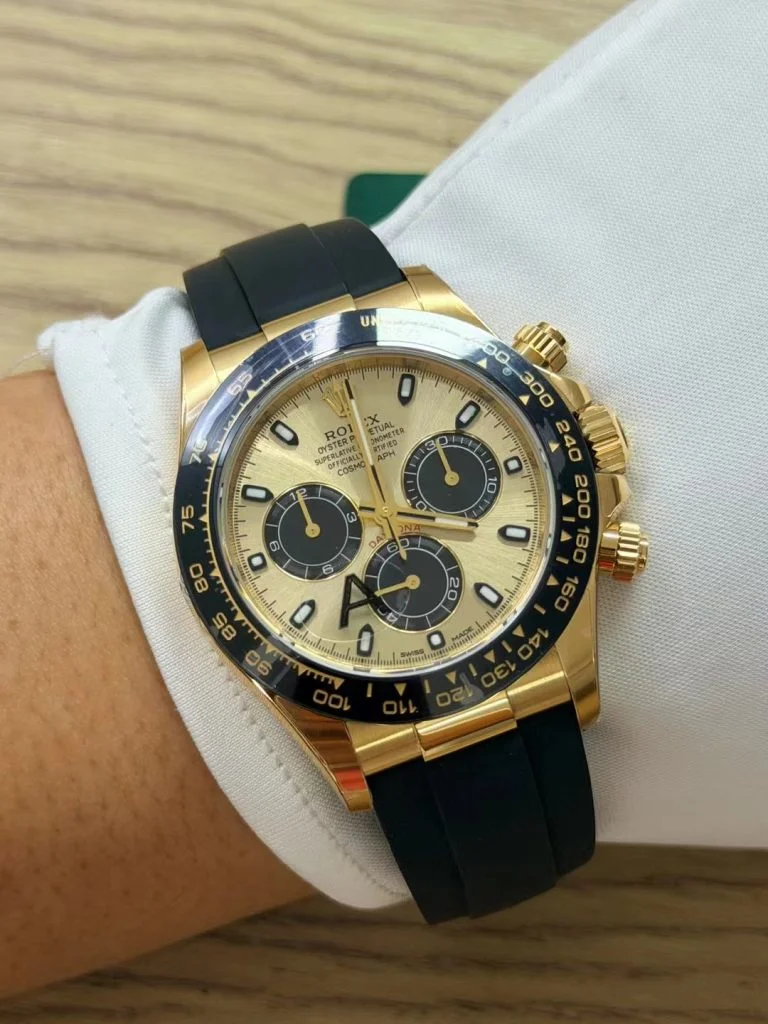
VSF updated their dial tooling. Across the champagne dial on the 126518LN and the diamond-set Everose 126515LN, the applied hour markers are visibly narrower and longer than the previous generation. The black snailed outer tracks on the sub-dials are thinner, which gives the dial more breathing room. The text printing has decent height to it — oil-ink application, not flat pad printing — and under a loupe the marker chamfering is even on all sides. The diamond version uses square settings that sit flush against the dial and reflect consistently under light.
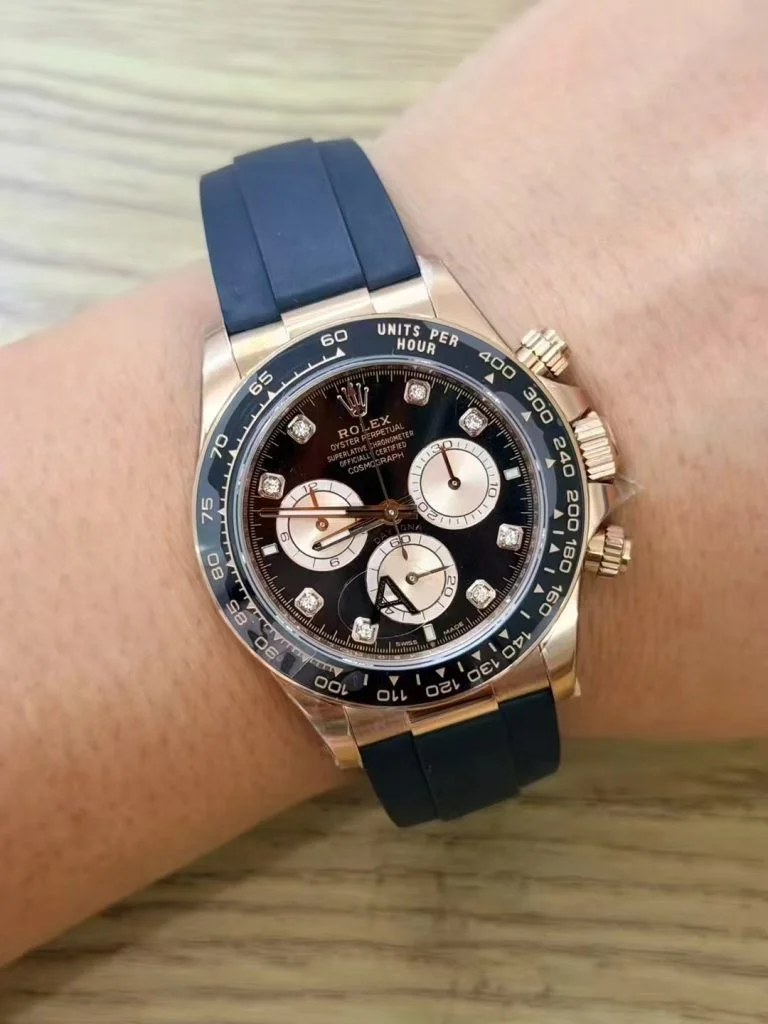
The micro-printed coronet at 6 o'clock between "SWISS" and "MADE" is there, matching the current-generation branding.
2. Bezel: metal-edged ceramic vs. full gold
This is the quickest way to tell a 126xxx Daytona from a 116xxx on Oysterflex. The 126xxx adds a thin metal ring — gold-plated 904L steel — around the outer edge of the ceramic bezel insert. It protects the ceramic edge from chipping and changes the visual profile of the watch. VSF's version sits flush against the ceramic, no visible gaps or uneven seating. It reads as a single cohesive assembly, which is how gen does it.
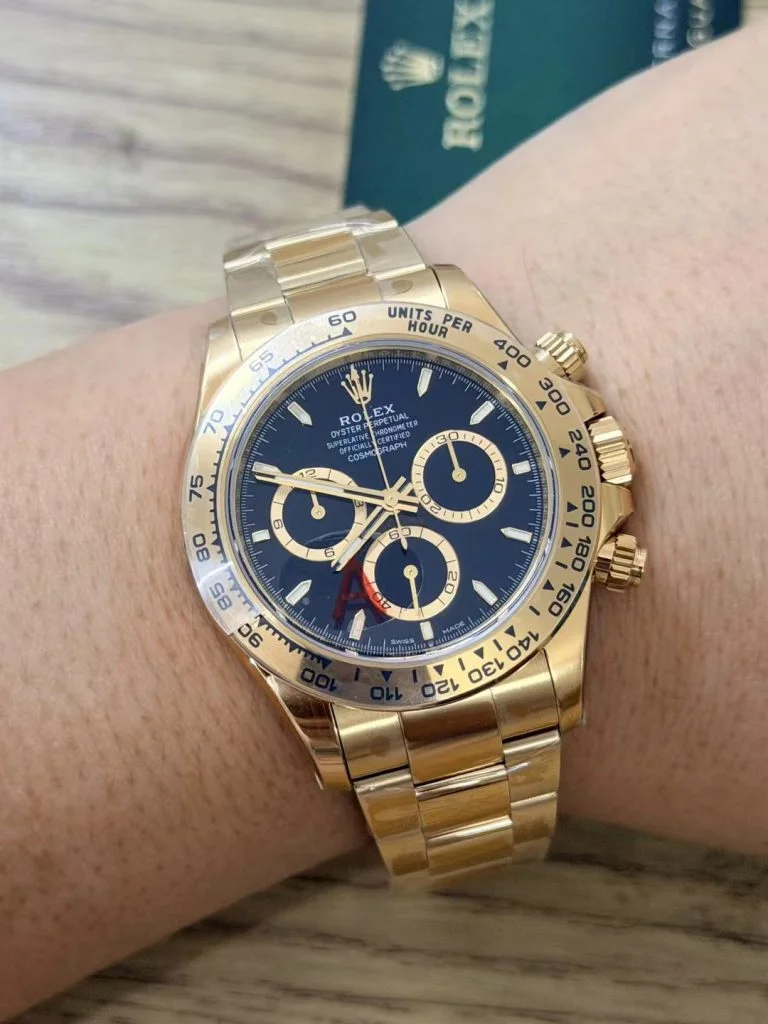
The full gold 126508 skips the ceramic insert entirely. It uses a high-polish gold bezel with CNC-etched tachymeter markings. The numerals are deep enough to catch light without washing out, filled via PVD. Legibility under direct sun is fine, which is where badly done gold bezels tend to turn into a mirror.
3. Strap and bracelet: Oysterflex and case finishing
The Oysterflex straps are fluoroelastomer, not silicone. VSF embedded internal titanium-nickel alloy blades inside the rubber, which is how Rolex does it — the metal core gives the strap structural memory so it holds its curve against the wrist instead of going limp over time. Silicone straps on cheaper versions don't have this, and they deform after a few months of daily wear.
The caseback and lugs are worth checking under a loupe. The lug geometry on the underside is rounded cleanly — no sharp transitions that dig into skin. The precious metal hallmarks are stamped on the back of the lugs: "Au750," the responsibility marks, the dog head emblem. They're legible under magnification and correctly positioned.
4. Movement: Dandong 4131 caliber
VSF used the Dandong 4131, which is an integrated chronograph movement — column wheel, vertical clutch, proper gear layout. This is not a modified 7750 with shifting plates. The 7750-based clones are thicker, less reliable, and the chronograph pusher feel gives them away immediately. The 4131 avoids all of that.
The movement holds a 72-hour power reserve from a single barrel, wound by a bidirectional rotor on ceramic ball bearings. Real-world rate stability on the unit we tested was within +/- 5 seconds per day, which is better than most people expect from a clone movement. The chronograph pushers engage with a clean mechanical click, no hand stutter when resetting. Crown operation — winding, date setting, time setting — matches gen feel and direction.
One note: the 4131 is still a clone movement. Serviceability depends on finding someone willing to work on it. The 7750-based clones are easier to get serviced because parts are ubiquitous. The 4131 is more accurate to gen architecture but fewer watchmakers know it. Trade-off worth mentioning.
5. Spec summary
| Parameter | VSF 126xxx | Standard competitors |
|---|---|---|
| Movement | Dandong 4131 (integrated, 72h) | Modified 7750 shifting plates, short reserve |
| Bezel | Metal-edged Cerachrom or CNC gold | Old 116xxx exposed ceramic (wrong profile) |
| Dial | Slimmed sub-dial rings, narrow indices | Thick markers, old 116xxx blank |
| Oysterflex | Fluoroelastomer with internal titanium blades | Basic silicone, no memory metal |
| Case finishing | 904L steel, multi-layer gold PVD, smooth lugs | 316L, rough lug transitions |
Bottom line: VSF got the 126xxx generation right where it counts: the dial proportions, the metal-edged bezel, and the movement. The Dandong 4131 is the main reason to pick this over cheaper alternatives. A 7750-based Daytona rep feels wrong the moment you use the chronograph. The 4131 doesn't.
The precious metal PVD is well executed but keep in mind it's still plating. It will wear over time, especially on the clasp and the edges of the lugs if you're not careful taking the watch on and off. That's not unique to VSF — it's the nature of PVD on any rep. The Oysterflex models dodge most of this because the strap covers the caseback contact points.
If you want a 126xxx Daytona in gold or Everose and you care about the dial, bezel, and movement being correct to generation, this is the current benchmark. Just factor in the serviceability question on the movement before you buy.